

Who Is Responsible for GPS Monitoring? The Transport Organizer or the Operator?
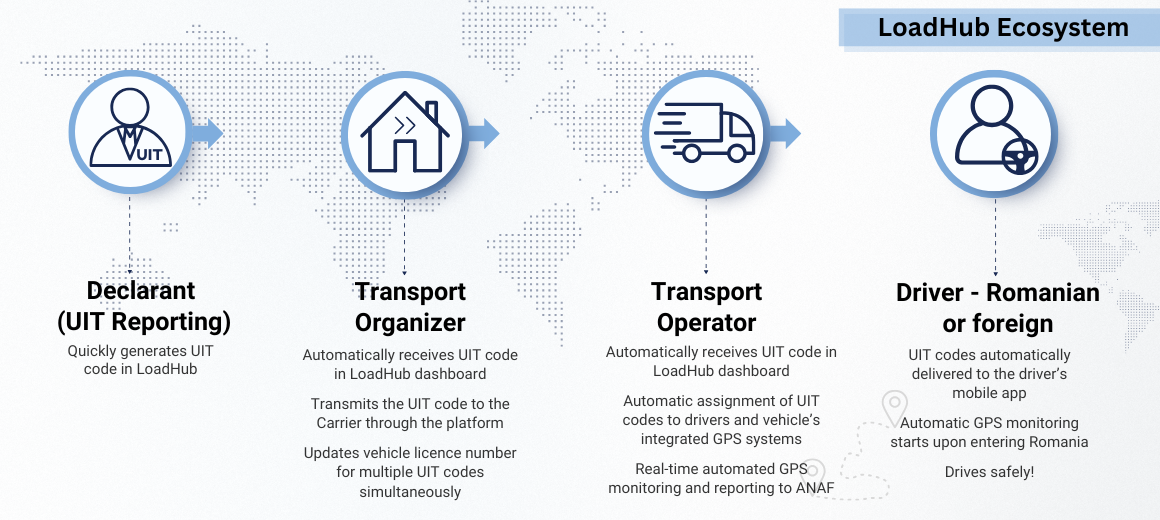
Two Distinct Roles, Different Obligations, and a Costly Misunderstanding During Inspections
Many transport operators and freight forwarders enter an e-Transport inspection convinced that “the other party is handling the GPS.” The transport operator assumes the organizer has arranged everything. The organizer assumes the carrier knows what to do. Meanwhile, GPS monitoring is either inactive or incorrectly started, and the fine typically reaches the party that put the truck on the road.
As inspections become more frequent, understanding the distinction between the transport operator and the transport organizer is critical for anyone involved in freight operations.
During an e-Transport inspection, authorities verify, among other aspects, who physically executed the transport, which vehicle was placed into circulation, and whether the GPS monitoring functioned throughout the entire journey under RO e-Transport legislation.
What Each Role Actually Means
Under RO e-Transport legislation (OUG 41/2022 and subsequent amendments), the two roles are treated separately, even if in practice they may sometimes be fulfilled by the same company.
The transport organizer is the entity that plans and coordinates the logistics of the transport, receives the order from the shipper, and transmits it to the carrier. The organizer may be mentioned in the UIT code. However, this entity does not necessarily own the vehicle, does not drive it, and does not exercise direct operational control over the truck. Freight forwarding companies typically act as transport organizers.
The transport operator is the entity that physically executes the transport. It places the vehicle on the road, employs or subcontracts the driver, and holds direct operational control over the truck throughout the trip. If your company owns or uses the vehicle transporting the goods, you are the transport operator – regardless of who organized or contracted the transport.
It is important to note that these roles can coexist within the same company. A freight forwarder that also operates its own fleet may act simultaneously as organizer (for subcontracted transports) and as transport operator (for transports carried out with its own vehicles). In such cases, the company assumes all corresponding legal obligations.
Who Is Responsible for GPS Monitoring?
This is the core issue and the main source of confusion in the market.
GPS monitoring is exclusively the responsibility of the transport operator – the entity that controls the vehicle and executes the transport. It is not the responsibility of the organizer, the declarant, or the freight forwarder if they do not operate the vehicle.
GPS monitoring must be manually initiated and stopped, either by the dispatcher via the web platform or by the driver through the mobile application. Ensuring that this action takes place at the correct moment is the responsibility of the transport operator.
Test LoadHub for Free with Volvo Connect Integration
• GPS monitoring • 7-day free trial • No drivers required • No obligations • No card details required for testing
Where Operational Errors Most Commonly Arise
In practice, the most common situations leading to non-compliance include:
The freight forwarder sends the UIT code “via WhatsApp” or email, without a clear workflow, and the carrier is unaware that the GPS monitoring must be activated.
The registration number in the UIT code does not match the actual vehicle because the tractor unit was changed, and the code was not updated in time.
GPS monitoring is not activated at all because the driver did not receive clear instructions or does not have access to the application.
It is assumed that the vehicle’s GPS reports automatically, without any actual integration with the e-Transport system.
None of these situations are accepted as a justification by the authorities. An e-Transport inspection verifies facts, not intentions.
How Companies Reduce the Risk of Fines
As the number of transports and subcontractors increases, manual management of the workflow between the declarant, organizer, and transport operator becomes a risk in itself. Communication errors, incorrect UIT data, or missed GPS activations become more frequent as volume grows.
Dedicated platforms such as LoadHub are designed to manage this integrated flow. The declarant can transmit the UIT code directly through the platform to the organizer, who forwards it to the carrier. The carrier can update the vehicle registration number directly in LoadHub, with the modification immediately reflected in SPV ANAF, without depending on further intervention from the declarant. The dispatcher manages GPS monitoring through the web platform without relying solely on drivers. If no GPS devices are installed in the fleet, the driver receives the UIT code in the mobile application and activates GPS monitoring from there.
Automation provided by solutions such as LoadHub helps companies save hours of work daily, reduce staffing costs associated with e-Transport administrative tasks, lower the risk of human error, and ultimately reduce exposure to fines.
The visibility offered by such a system—where each participant clearly understands their responsibilities and actions are traceable—significantly reduces the risk of non-compliance for all parties involved.
Practical Implications
Understanding and correctly applying this distinction means that you eliminate one of the most common sources of non-compliance in practice.
If you manage high transport volumes or work with subcontractors, it is essential to implement clear processes and use a solution that provides visibility and control over actual operational execution, not just documentation.