

When Is a UIT Code Mandatory? The Complete 6-Step Framework
Many entrepreneurs and transport operators find themselves facing the same situation. They know the RO e-Transport system exists, and they know there is such a thing as a UIT code, but they are often unsure whether a specific transport operation is actually subject to these obligations. The answer is not always simple. It depends on several factors which need to be assessed in the right order.
That is exactly why the framework posted below matters. Created by Economist Eduard Păun of Contapro, one of Romania’s best-known tax specialists, and updated in line with the legislation in force on 1 January 2026, it offers one of the clearest and most comprehensive explanations currently available. LoadHub supported its publication because we believe it is one of the most comprehensive and useful resources available on the market for understanding when the UIT code is truly mandatory.
Table of Contents
The Framework for Determining When a UIT Code Is Required in RO e-Transport
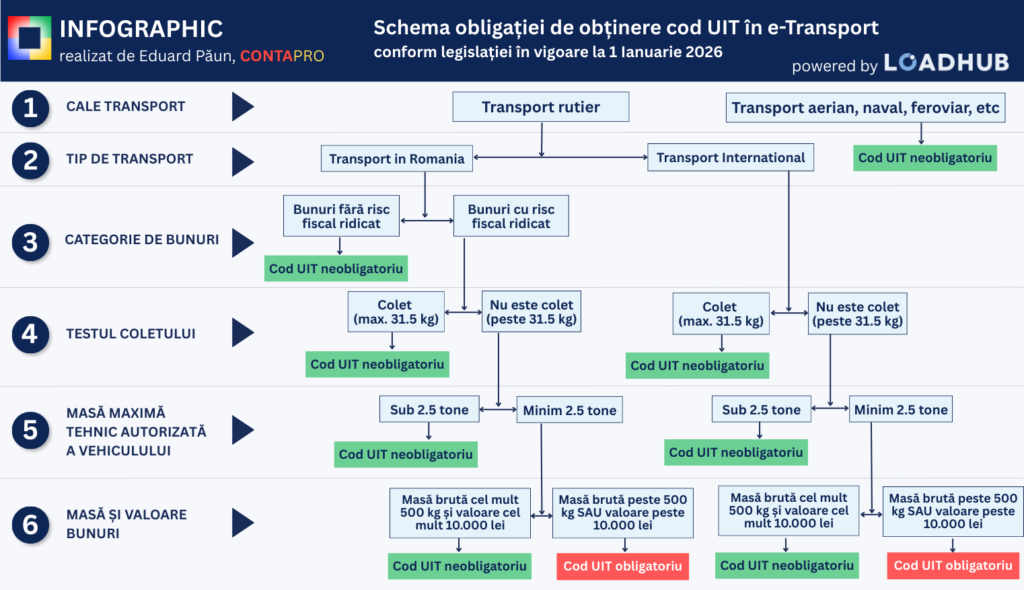
Source: Economist Eduard Păun, Contapro. Framework for Determining When a UIT Code Is Required in RO e-Transport, based on the legislation in force as of 1 January 2026 — powered by LoadHub
Why This Framework and Not Another One?
There are many articles and guides about the UIT code, but many of them share the same weakness: they either omit important edge cases or explain the original 2022 version of the legislation without incorporating the later amendments introduced by Emergency Ordinance 87/2024, Order 1337/1268/2024, and Emergency Ordinance 29/2025.
Eduard Păun’s framework solves this by using a decision-tree structure based on 6 successive tests. Each test removes one category of transport from the scope of the UIT obligation, making the analysis easier to follow and much harder to misinterpret.
Simple. Visually clear, with no unnecessary guesswork.
What Goods Are Classified as High Fiscal Risk Goods (HFRG)?
In the case of domestic transport, the UIT reporting obligation applies only to high fiscal risk goods (HFRG), as defined by ANAF Order No. 802/2022. If the goods being transported are NOT included on this list, a UIT code is not required.
The main HFRG categories include:
- vegetables, plants, edible roots and tubers (CN codes 0701–0714)
- edible fruit; citrus fruit or melon peel (CN codes 0801–0814)
- beverages, alcoholic liquids, and vinegar (CN codes 2201–2208)
- salt, sulphur, earths and stone, plaster materials, lime, and cement (CN codes 2505 and 2517)
- knitted or crocheted apparel and clothing accessories (CN codes 6101–6117)
- apparel and clothing accessories other than knitted or crocheted (CN codes 6201–6212 and 6214–6217)
- footwear, gaiters, similar articles, and parts thereof (CN codes 6401–6405)
- iron and steel (CN codes 7213 and 7214)
Generate UIT Codes 5x Faster
• No ANAF token required (only needed once when creating the account) • Save product, partner, and address lists • No repeated logins • Save an incomplete UIT code and complete it later when you have all the required data
UIT Code Reporting Criteria
1. Mode of Transport
RO e-Transport applies only to road transport operations carried out in Romania. The UIT code is not required for air, maritime, rail, or any other types of transport.

2. Type of Transport and 3. Category of Goods
domestic road transport (carried out within Romania) – only for high fiscal risk goods
international transport – applies to all categories of goods
transit through Romania – only where the goods are unloaded for storage or for the creation of a new shipment, from one or more consignments, on Romanian territory
4. The Postal Parcel Test
This is a lesser-known but important test: are the goods being transported as a postal parcel, with a maximum weight of 31.5 kg, by an authorized postal operator?
If the answer is yes → the UIT code is not required. As a rule, this exception generally covers standard courier deliveries and small e-commerce shipments.
5. Tipul vehiculului
The fifth criteria concerns the vehicle rather than the goods: the vehicle’s maximum technically permissible laden mass must be at least 2.5 tonnes.
Vehicles with a mass below 2.5 tonnes – such as small utility vehicles or light vans – are not subject to this obligation, even when they carry high fiscal risk goods.
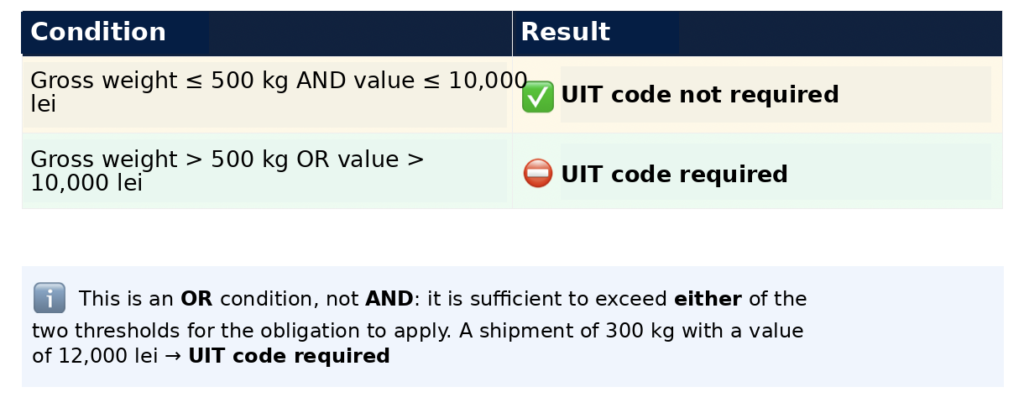
6. Weight and Value of the Goods
he final test – and the one that ultimately determines whether a UIT code is required – checks whether the shipment exceeds at least one of the following thresholds:
Three Practical Examples
Exemplul 1: Transport național de fructe
An 18-ton truck transports 4,000 kg of oranges (CN 0805) from Constanța to Cluj, with a shipment value of RON 22,000. → A UIT code is required.
Example 2: Delivery by Small Van
A van with a maximum technically permissible laden mass of 2.3 tonnes delivers clothing (high fiscal risk goods) worth RON 15,000. → A UIT code is not required. Even though the value exceeds the legal threshold, the vehicle keeps the transport outside the scope of the reporting obligation.
Example 3: International Furniture Transport
A 40-ton truck transports furniture (which is not classified as high fiscal risk goods) from Germany to Romania. → A UIT code is required, because in the case of international transport, the reporting obligation applies regardless of the category of goods.
What Happens If the UIT Code Is Missing or Incorrect?
The sanctions for failing to declare a shipment in the RO e-Transport system, as well as for a missing UIT code or discrepancies between the declared data and the actual goods loaded psysically in the vehicle, are provided for in Art. 13¹ of Emergency Ordinance No. 41/2022:
for legal entities: fines from RON 20,000 to RON 100,000
for individuals: fines from RON 10,000 to RON 50,000
If the same offence is repeated within 12 months, in addition to the fine, the authorities may also confiscate 15% of the value of the undeclared goods for a second offence, 50% for a third offence, or 100% for a fourth offence.
The sanctions are imposed by ANAF, the Romanian Customs Authority, and the Romanian Police.
Read more → “RO e-Transport UIT Code Fines: What You Risk and How to Avoid Them”
When Is a UIT Code Not Required?
According to Art. 16 of Emergency Ordinance No. 41/2022, the following transport operations are exempt from the obligation to generate a UIT code:
a) the transport of goods intended for diplomatic missions, consular offices, international organizations, the armed forces of NATO member states, the European Union, and similar entities
b) the transport of excise goods moving under an excise duty suspension regime or with excise duty already paid in the Member State of dispatch, in accordance with Title VIII, “Excise Duties and Other Special Taxes,” of Law No. 227/2015
c) the transport of goods by postal service providers in the form of postal parcels
Read the full list of exceptions in the article →“Exceptions to the RO e-Transport System: When Is a UIT Code NOT Required?”
Alte articole





Share the Post: