

What Is the UIT Code and How Does It Work in RO e-Transport?
Since January 2023, the transport of goods in Romania has been monitored through the RO e-Transport system, with the UIT code serving as the central element of this system.
A 16-character alphanumeric string can can make the difference between your vehicle passing an ANAF inspection without issues and receiving a fine ranging from RON 20,000 to RON 100,000.
Because there is still confusion among both declarants and carriers, in this article we will explain:
Under Art. 2 point 11 of Emergency Ordinance No. 41/2022, the UIT code (Unique Transport Identification Code) is defined as:
“The unique code generated by the RO e-Transport System through which the data related to a shipment of goods is identified.”
The UIT code is a 16-character alphanumeric code, automatically generated by the ANAF system once the declarant company submits the transport data.
A random example of a UIT code looks like this: Y45R-577U-N544-GY4S.
Through this UIT code, the authorities can access the complete transport information, including the sender and recipient details, description, quantity, and value of the goods, loading and unloading locations, vehicle and carrier details, as well as the estimated transport period.
How Does the UIT Code Work in the RO e-Transport System?
The RO e-Transport system was introduced to monitor the transport of goods and to combat tax evasion in in certain sectors of the economy. Within this system, the UIT code serves as the main reference for each declared shipment.
The RO e-Transport system involves four categories of actors, each with distinct responsibilities: the Declarant, the Transport Organizer, the Transport Operator, and the Driver.
Who Must Generate the UIT Code?
The Declarant (the System User) is the party responsible for generating the UIT code. According to Emergency Ordinance No. 41/2022, Articles 8 and 8¹ and depending on the type of transport, this obligation generally falls on the following party:
the supplier – for domestic transport of high fiscal risk goods
the Romanian beneficiary – for intra-Community acquisitions
the Romanian supplier – for intra-Community supplies
the consignee named in the import customs declaration
the sender named in the export customs declaration
the warehouse keeper – for goods involved in intra-Community transit transactions
Once the UIT code has been generated, it must be sent to both the carrier and the driver before the transport begins or before the vehicle enters Romania.
Important ❗ The carrier does not generate UIT codes. However, under Art. 8² of Emergency Ordinance No. 41/2022, the carrier must receive the code from the declarant and ensure that it is made available to the driver.
The driver must be able to present the UIT code, together with the transport documents, whenever these are requested by the inspection authorities – ANAF, the Romanian Customs Authority, or the Romanian Police.
The confusion between the roles of Declarant and Carrier is one of the most common causes of fines. For more details, read → “How to Manage RO e-Transport Correctly If Your Company Is Both the Declarant and the Carrier”
What Types of Transport Require a UIT Code?
The RO e-Transport legislation applies only to road transport operations carried out on Romanian territory.

Domestic transport – all transport operations involving high fiscal risk goods (HFRG) that start and end in Romania
International transport or import/export – any transport operation that starts or ends in Romania (import, export, intra-Community acquisition, or intra-Community supplies). All categories of goods are covered if they exceed 500 kg or RON 10,000
Transit – all transport operations that pass through Romanian territory without a final destination in Romania, but only where the goods are unloaded for storage or for the creation of a new shipment
Need a UIT Code Urgently?
We generate it for you quickly, accurately, and efficiently.
When Must the UIT Code Be Generated?
Mandatory Reporting Thresholds
The UIT code must be generated before the vehicle begins the transport operation or before it enters Romania:
1. For domestic transport – only for high fiscal risk goods (HFRG) transported by a vehicle with a maximum technically permissible laden mass of more than 2.5 tonnes, and only if the shipment exceeds 500 kg gross weight or RON 10,000 in value (excluding VAT) per consignment.
2. For international transport – for all categories of goods where the shipment exceeds 500 kg gross weight or RON 10,000 in value (excluding VAT) per consignment. This includes operations such as imports, exports, intra-Community acquisitions (ICA), and intra-Community supplies (ICS). In these cases, the code must be generated before the vehicle arrives at the road border crossing point for entry into Romania.
How Is a UIT Code Generated?
Obtaining a valid UIT code requires following the procedures established by ANAF through the SPV platform. In practice, there are several ways to generate a UIT code:
Through the RO e-Transport system in ANAF SPV – The declarant logs into the Virtual Private Space (SPV) on the ANAF website using the company’s digital signature token. They then manually enter the required information: sender, recipient, goods details (name, quantity, weight, value, CN code), vehicle, carrier, route, and estimated transport date. The system validates the information and generates the UIT code.
Through accounting or invoicing software integrated with ANAF’s e-Transport server – Many invoicing and dispatch solutions are already integrated with e-Transport. Based on a document issued by the user – such as an invoice, dispatch note, or delivery document – the system collects the relevant data. The user then adds the missing transport-specific details, such as the vehicle registration number, route, carrier, and estimated transport date. The software then sends the data to ANAF and returns the UIT code.
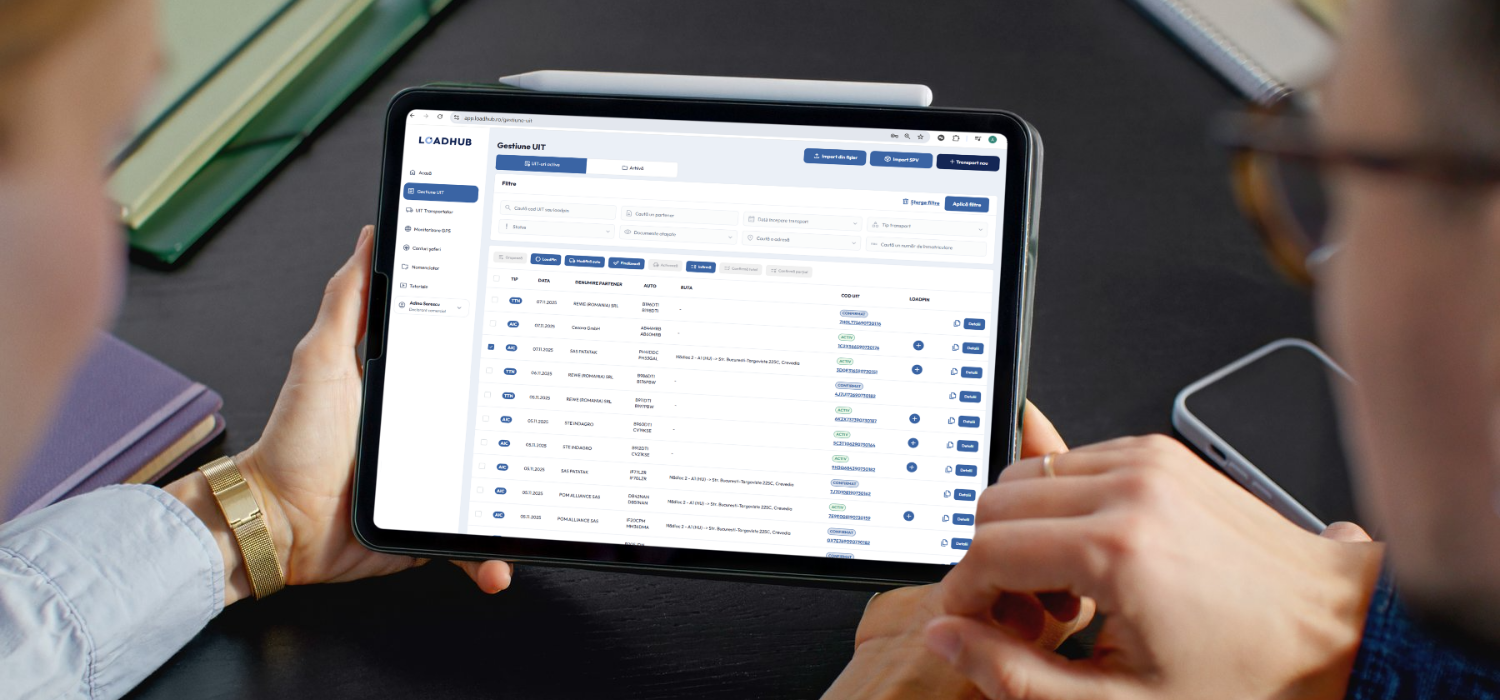
Through dedicated ANAF-authorized e-Transport platforms, such as LoadHub – These platforms are built specifically for UIT code management and GPS monitoring. The user creates a company account and connects the digital signature token during the initial setup. After that, UIT codes can be generated without needing to use the ANAF token each time. The required declaration information – sender, recipient, goods, vehicle, carrier, and route – is completed once, sent automatically to ANAF, and the system then returns the UIT code. These platforms can also store product lists, partners, and addresses, reducing repetitive manual work. Several also offer features such as fast UIT generation (in 30 seconds) or allow users to save incomplete UIT drafts – useful when the vehicle registration number is received late. If the ANAF server is offline, declarations can be saved and then resubmitted automatically, saving time.
Through outsourced or on-demand UIT code generation services – If the declarant does not have the internal resources, know-how, or token access needed to manage the process on their own, they can use an accounting firm or a specialized on-demand UIT code generation service (LoadHub also offers this service). In that case, the user sends the required documents and shipment data, and the service provider generates and returns the UIT code on their behalf.
Through direct API integration for large ERP systems and internal software – This is the method typically used by large companies and dedicated software solutions. ANAF provides API microservices that allow internal systems to send declarations directly to the e-Transport system. This option requires time and significant financial investment, but it can be an efficient solution for retailers and enterprise-scale companies.
For a more in-depth analysis to help you pick the best UIT generation method for your business, see the article → “How to Generate a UIT Code: Comparing the Different Methods Available on the Market”
How Long Is a UIT Code Valid?
The validity period of a UIT code is calculated from the declared start date of the transport, not from the date the code is generated. Declarants may generate the UIT code up to 3 calendar days before the start date of the transport.
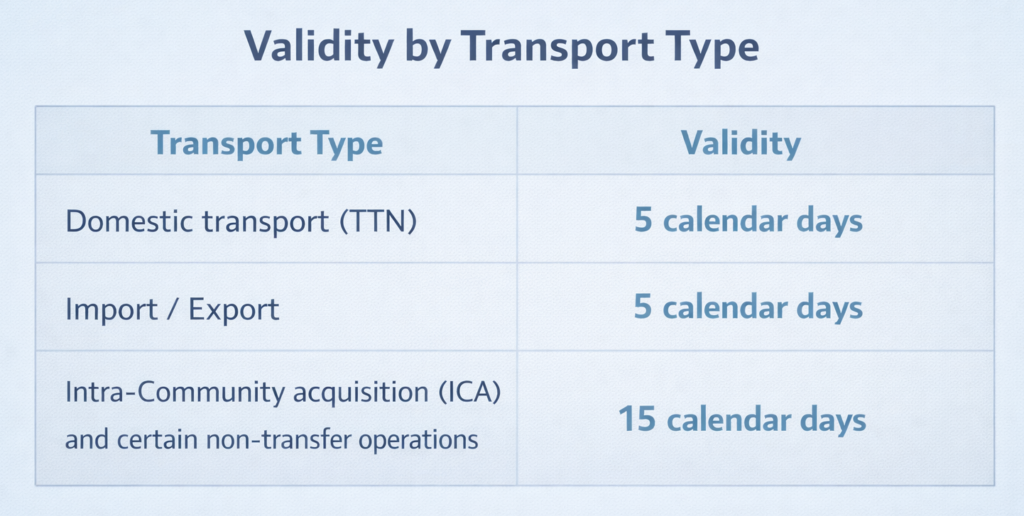
Using a UIT code after it has expired is prohibited and constitutes an administrative offence. If the transport is not completed within the validity period, the declarant must invalidate the old code and obtain a new one.
How Is the UIT Code Verified During an e-Transport Inspection?
Generating a UIT code is only half of the compliance process. The other half is the carrier’s obligation to report the GPS location of the goods, while the drivers must also be able to present the UIT code during inspections. Authorities accept printed documents containing the code and a summary of the related declaration, as well as digital displays on smartphones, tablets, or in-cab IT systems.
On 4 March 2025, ANAF anti-fraud inspectors stopped 4,589 vehicles in a single day during nationwide monitoring operations and applied sanctions totaling RON 1,957,300. Some of those sanctions resulted from UIT-related breaches, including missing codes, expired codes, and discrepancies between the declared cargo and the goods physically found in the vehicle.
Sanctions may be identified and imposed by ANAF, the Romanian Customs Authority, and officers and police agents of the Romanian Police.
When inspectors request the UIT code during an e-Transport inspection, they verify whether the shipment has a valid UIT code, whether the transported goods match the declared goods, whether the declared vehicle is the same as the vehicle being inspected, and whether the transport is taking place within the code’s validity period. Any discrepancies between the declared data and the physical findings may result in fines ranging from RON 20,000 to RON 100,000 for the Declarant.
How LoadHub Simplifies UIT Code Generation
LoadHub is a complete compliance platform for RO e-Transport declarations, which is also officially registered with ANAF. It allows companies to generate UIT codes in multiple ways: through a guided workflow, by cloning a previous UIT, or by importing the shipment’s data from Excel.
The platform also provides:
automatic SPV synchronization
no need to repeatedly use the digital signature token
access from any laptop, tablet, or location
automatic checks and validations that help prevent the most frequent errors
fast editing, confirmation, and cancellation of UIT codes
GPS monitoring for carriers
No matter the volume of UIT codes that your company manages each month, the Declarant plan gives you simpler access to e-Transport, as well as technical support.
No time to learn the platform at this time? LoadHub also offers an on-demand UIT code generation service – just send us the documents and you will receive your UIT code in up to 30 minutes.
Alte articole



Share the Post: