
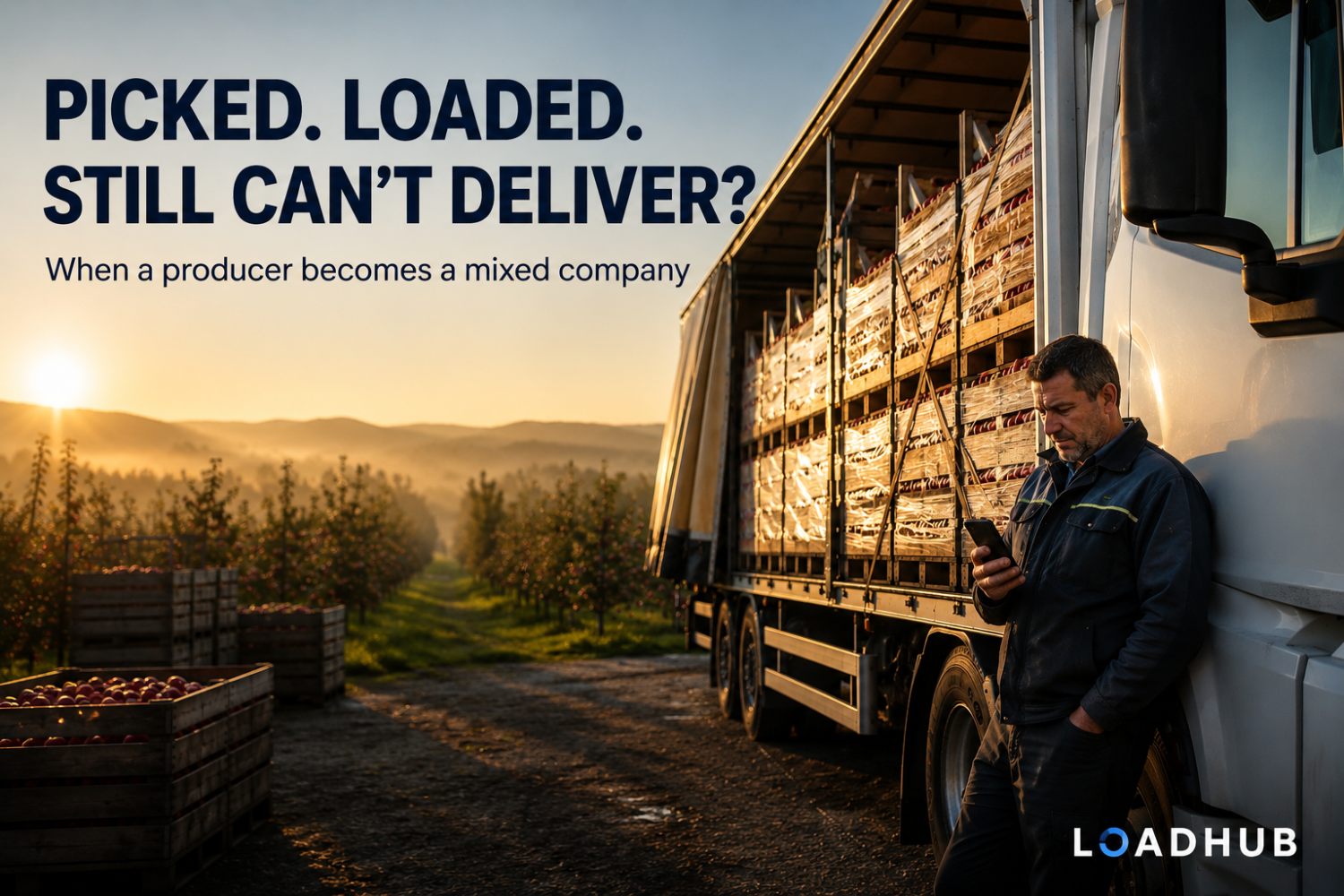

Meet Florin: his apples are picked, the truck is loaded, and he can’t deliver — all because of a code
Florin grows apples in the Argeș region of Romania. An orchard he inherited and expanded year after year, with varieties he knows by taste, not by their customs code. This year he finally took the step he’d been putting off: he signed a distribution contract with a retail chain. Steady volume, firm orders, delivery with his own trucks — exactly how he wanted it, with no middlemen eating into his margin.
At signing, the buyer mentioned it almost in passing: “Right, and you’ll need a UIT code for every delivery.” Florin nodded. He had no idea what that meant.
He asked his accountant. She confirmed that yes, there’s a system, RO e-Transport, and that apples fall under it. But when he asked the practical questions — who issues the code, when, from where, what the driver needs in hand before leaving — the answers got vaguer. “Let’s see when the first delivery comes.” The first delivery has now come.
It’s peak season. The apples are picked, sorted, palletized. Florin’s truck was loaded last night, the driver is behind the wheel with his coffee finished, the store expects stock on the shelf before opening. And still the truck sits in the yard.
Because a string of 16 characters is missing.
Florin calls the accountant. It’s Saturday. He calls again. Meanwhile, a few things nobody had spelled out for him start to sink in:
The UIT code must be generated before the vehicle moves — not at a roadside check, not en route.
To generate it you need a digital signature token connected in ANAF’s SPV portal — and the token is in the accountant’s desk drawer, locked away until Monday.
His apples count as high fiscal risk goods (fruit, NC 0808). For national transport above 500 kg or 10,000 RON per consignment, with a vehicle over 2.5 tonnes, the UIT code is mandatory. His truck ticks every box.
If he leaves without a code and gets stopped, the fine for legal entities runs from 20,000 to 100,000 RON. The price of several trailers of apples.
Florin isn’t careless. Florin is a grower, not a transport-tax specialist. And his problem was never the goods — the goods are flawless. The problem is that he found out too late that the moment he started hauling his own apples to the store, he quietly became two things at once.
At signing, the buyer mentioned it almost in passing: “Right, and you’ll need a UIT code for every delivery.” Florin nodded. He had no idea what that meant.
He asked his accountant. She confirmed that yes, there’s a system, RO e-Transport, and that apples fall under it. But when he asked the practical questions — who issues the code, when, from where, what the driver needs in hand before leaving — the answers got vaguer. “Let’s see when the first delivery comes.” The first delivery has now come.
Saturday morning, the truck is full and going nowhere
It’s peak season. The apples are picked, sorted, palletized. Florin’s truck was loaded last night, the driver is behind the wheel with his coffee finished, the store expects stock on the shelf before opening. And still the truck sits in the yard.
Because a string of 16 characters is missing.
Florin calls the accountant. It’s Saturday. He calls again. Meanwhile, a few things nobody had spelled out for him start to sink in:
The UIT code must be generated before the vehicle moves — not at a roadside check, not en route.
To generate it you need a digital signature token connected in ANAF’s SPV portal — and the token is in the accountant’s desk drawer, locked away until Monday.
His apples count as high fiscal risk goods (fruit, NC 0808). For national transport above 500 kg or 10,000 RON per consignment, with a vehicle over 2.5 tonnes, the UIT code is mandatory. His truck ticks every box.
If he leaves without a code and gets stopped, the fine for legal entities runs from 20,000 to 100,000 RON. The price of several trailers of apples.
Florin isn’t careless. Florin is a grower, not a transport-tax specialist. And his problem was never the goods — the goods are flawless. The problem is that he found out too late that the moment he started hauling his own apples to the store, he quietly became two things at once.
Using LoadHub there is no need to login into SPV
You have 3 different ways of generating UIT codes. Fast and reliable.
Florin isn’t just a producer. He’s a “mixed company”
The term doesn’t exist in the law, but it describes his situation exactly: whoever produces the goods and moves them with their own fleet carries two e-Transport roles at the same time.As the Declarant, Florin is obliged to generate the UIT code for every apple delivery above the thresholds. He’s the supplier, so the declaration falls on him.As the transport operator, because he puts his own truck on the road, Florin has three more obligations he didn’t even know he had:
LoadHub’s MAX plan is built precisely for mixed companies like Florin’s — the ones that declare UIT codes and monitor their own transports, from a single platform. Here’s how the scene above changes.
The code takes 60 seconds, on Saturday morning, from the kitchen table. Florin connects his ANAF token once, when setting up the account. After that he generates UIT codes without depending on the token, on SPV, or on the accountant’s schedule — from a laptop or phone, anywhere. A step-by-step wizard guides him and validates the data before sending it to ANAF.
The second delivery takes even less. The retail chain receives the same goods on the same routes. Florin clones a previous code, changes the date and plate number, and he’s done — 30 seconds. His product lists (apple varieties, NC codes), partners, and delivery addresses are already saved; no retyping every time.
The driver gets the code on his phone, not over WhatsApp. From the platform, the UIT code lands automatically in the driver’s LoadHub mobile app, assigned to the vehicle he’s driving. No screenshots, no “read me that code again.”
GPS monitoring starts on its own. Florin connects his fleet’s GPS provider, or — if a truck has no GPS — the driver starts monitoring from the app. Coordinates reach ANAF automatically, for the whole trip, without anyone remembering to hit start and stop. The dependence on the driver disappears.
If the truck changes, the code updates in seconds. A truck breaks down mid-season? Florin changes the plate number in the code straight from the platform, at any hour, without calling anyone. The goods no longer wait on paperwork.
At unloading, he confirms with one click, and the status syncs automatically in ANAF. On the dashboard he sees every code and every truck on a live map.
The MAX plan includes 10 users, 500 UIT codes per month, and 7 GB of storage — enough for a producer moving seriously into distribution. GPS monitoring and fleet-provider integration are enabled as paid add-ons, depending on how many trucks he runs. Full setup takes around 15 minutes.
- transmit the vehicle’s GPS coordinates to ANAF for the entire trip;
- update the plate number in the code if he swaps the truck or trailer;
- hand the UIT code to the driver before departure.
LoadHub’s MAX plan is built precisely for mixed companies like Florin’s — the ones that declare UIT codes and monitor their own transports, from a single platform. Here’s how the scene above changes.
The code takes 60 seconds, on Saturday morning, from the kitchen table. Florin connects his ANAF token once, when setting up the account. After that he generates UIT codes without depending on the token, on SPV, or on the accountant’s schedule — from a laptop or phone, anywhere. A step-by-step wizard guides him and validates the data before sending it to ANAF.
The second delivery takes even less. The retail chain receives the same goods on the same routes. Florin clones a previous code, changes the date and plate number, and he’s done — 30 seconds. His product lists (apple varieties, NC codes), partners, and delivery addresses are already saved; no retyping every time.
The driver gets the code on his phone, not over WhatsApp. From the platform, the UIT code lands automatically in the driver’s LoadHub mobile app, assigned to the vehicle he’s driving. No screenshots, no “read me that code again.”
GPS monitoring starts on its own. Florin connects his fleet’s GPS provider, or — if a truck has no GPS — the driver starts monitoring from the app. Coordinates reach ANAF automatically, for the whole trip, without anyone remembering to hit start and stop. The dependence on the driver disappears.
If the truck changes, the code updates in seconds. A truck breaks down mid-season? Florin changes the plate number in the code straight from the platform, at any hour, without calling anyone. The goods no longer wait on paperwork.
At unloading, he confirms with one click, and the status syncs automatically in ANAF. On the dashboard he sees every code and every truck on a live map.
The MAX plan includes 10 users, 500 UIT codes per month, and 7 GB of storage — enough for a producer moving seriously into distribution. GPS monitoring and fleet-provider integration are enabled as paid add-ons, depending on how many trucks he runs. Full setup takes around 15 minutes.
The real takeaway
Florin never had a problem with his apples. He had a problem with a system that assumes that if you haul your own goods, you already know you’ve become both declarant and transporter — codes, token, GPS and all.LoadHub fills exactly that gap. It lifts e-Transport compliance off the shoulders of a man who should be tending the orchard and the contracts, not logging into SPV on a Saturday morning. The code takes seconds, it reaches the driver by itself, the GPS reports on its own, and Florin gets back to what he does best.For a producer who takes his own goods to the shelf, that’s the difference between “I’ll wait until Monday for someone to make me a code” and “the truck leaves on time, compliant, tracked all the way to the store.”
Other articles




Share the Post: